
PREVENAR 13#
PREVENAR 13 is a pneumococcal conjugate vaccine promoted to provide active immunization against invasive disease and otitis media caused by 13 serotypes of Streptococcus pneumoniae bacteria. It contains purified capsular polysaccharides from each serotype individually conjugated to a diphtheria CRM197 carrier protein, which causes a more pronounced immune response particularly in infants and young children. The vaccine is administered to infants, children, and adults for pneumonia.
Mechanism of Action#
What the Mechanism Affects#
Prescribed For#
- Invasive Pneumococcal Disease (IPD): Active immunization for sepsis, meningitis, and bacteraemia caused by S. pneumoniae serotypes 1, 3, 4, 5, 6A, 6B, 7F, 9V, 14, 18C, 19A, 19F, and 23F in infants and children from 6 weeks to 5 years of age.
- Acute Otitis Media: For middle ear infections caused by S. pneumoniae serotypes 4, 6B, 9V, 14, 18C, 19F, and 23F in children 6 weeks through 5 years (no efficacy data for serotypes 1, 3, 5, 6A, 7F, 19A).
- Pneumococcal Pneumonia: Prevention of community-acquired pneumonia caused by vaccine serotypes in adults 50 years and older.
- High-Risk Adults: For invasive disease in adults 18-64 years with certain medical conditions (immunocompromised, chronic illness, HIV, sickle cell disease).
Contraindications & Warnings#
Absolute Contraindications & Major Precautions
Adverse Effects Profile#
Common Side Effects#
- Injection Site Reactions: Pain/tenderness (89%), erythema/redness (70%), swelling (44.5%), induration (32.6%)
- Systemic – Infants/Children: Irritability (85.6%), drowsiness/increased sleep, restless sleep/decreased sleep, decreased appetite (51%)
- Fever: Very common in children 6 weeks-5 years and adults 18-29 years
- Systemic – Adults: New muscle pain (82%), aggravated muscle pain (55.9%), new joint pain (41.7%), chills (38.1%), headache, fatigue
- Limitation of arm movement (common in adults)
Serious Side Effects#
- Anaphylaxis: Anaphylactic/anaphylactoid reactions including shock (post-marketing). Life-threatening and requires immediate medical attention.
- Hypersensitivity Reactions: Face edema, dyspnea, bronchospasm, angioneurotic edema
- Seizures: Including febrile seizures. Increased reporting with concomitant DTPa-HBV-IPV/Hib vaccination. Febrile seizures: 1 in 6,000 when given with influenza vaccine.
- Hypotonic-Hyporesponsive Episode (HHE): Rare but serious neurological reaction.
- Apnea: In very premature infants (≤28 weeks gestation), potentially life-threatening.
- Erythema Multiforme: Severe skin reaction (post-marketing).
- Lymphadenopathy: Localized to vaccination site region.
- Death: Including sudden infant death syndrome (SIDS) reported in clinical trials and post-marketing surveillance, although causality denied by the drug companies.
Drug Interactions#
Active & Inactive Ingredients#
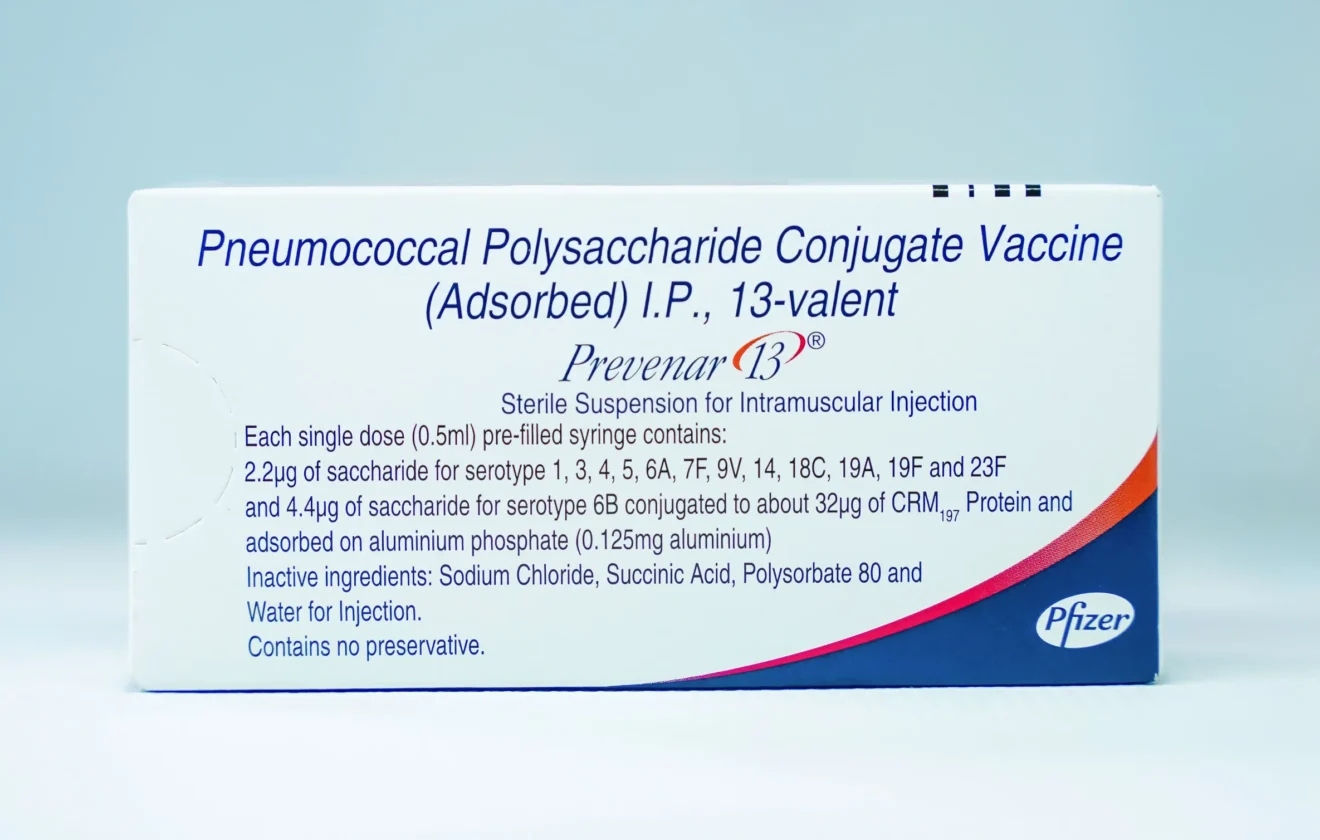
The multidose vial (4 x 0.5 mL doses) formulation of PREVENAR 13 contains the following components:
Active Substances (Per 0.5 mL Dose)#
- Polysaccharide Serotypes 1, 3, 4, 5, 6A, 7F, 9V, 14, 18C, 19A, 19F, 23F: 2.2 µg each (conjugated to CRM197)
- Polysaccharide Serotype 6B: 4.4 µg (conjugated to CRM197)
- CRM197 Carrier Protein: Approximately 32 µg (diphtheria toxin mutant derived from Corynebacterium diphtheriae cultures, purified from genetically modified bacterial strains)
Adjuvant#
- Aluminum Phosphate: 0.125 mg aluminum per dose (neurotoxic heavy metal, accumulates in brain tissue, linked to developmental delays and autoimmune conditions)
Preservative (Multidose Vial Only)#
- 2-Phenoxyethanol: 4 mg per dose (8 mg/mL concentration) – Neurotoxic preservative, can cause vomiting, diarrhea, CNS depression. Used in antifreeze and as industrial solvent. FDA warns against use in infants but allows in vaccines. If ingested it is considered a toxic poison.
Excipients (Inactive Ingredients)#
- Sodium Chloride: 4.25 mg (isotonicity agent)
- Succinic Acid: 0.295 mg (pH buffer)
- Polysorbate 80: 0.1 mg (detergent/emulsifier – increases blood-brain barrier permeability, allowing vaccine components greater access to brain tissue including the aluminum)
- Water for Injection: q.s. to 0.5 mL
Important Note: The vaccine is formulated based on saccharide content. Protein amount is dependent on polysaccharide/protein conjugation ratios. Single-dose prefilled syringes do NOT contain 2-phenoxyethanol preservative. All polysaccharides are chemically activated and covalently linked to CRM197 through reductive amination.
Clinical Trials & Efficacy#
Critical Note: The protective efficacy of PREVENAR 13 against invasive pneumococcal disease (IPD) has NOT been directly studied. Approval was based on immunogenicity comparisons (antibody levels) to the 7-valent Prevenar vaccine, using WHO-recommended surrogate endpoints.
Primary Immunogenicity Studies (none of these studies are valid because they neither test efficacy against disease nor safety against placebo#
- Study 006 (Germany): 2, 3, 4 month primary series. For 7 common serotypes, PREVENAR 13 met non-inferiority criteria except serotype 6B (77.5% vs 87.1% achieving ≥0.35 µg/mL IgG), missing by small margin. For 6 additional serotypes, 91.9-99.3% achieved antibody threshold, compared to 87.1% lowest response in Prevenar group.
- Study 004 (USA): 2, 4, 6 month series. Missed non-inferiority for serotypes 6B and 9V by small margins. Serotype 3 response: only 63.5% achieved threshold (vs 98.2% in Study 006).
- Preservative Study: 250 infants received PREVENAR 13 with 2-phenoxyethanol at 8, 12, 16 weeks. Non-inferiority demonstrated for all serotypes. OPA GMT lower for serotype 3, higher for 18C in preserved group. One case of sudden infant death syndrome occurred 20 days after third dose (assessed as unrelated).
Functional Antibody Response (OPA)#
- 91.4-100% of vaccinees achieved OPA titer ≥1:8 for all 13 serotypes after primary series
- Lower OPA geometric mean titers observed for serotypes 1, 3, and 5 compared to other additional serotypes (clinical significance unknown)
- Serotype 3 immune response NOT increased after booster dose compared to infant series (immunological memory induction uncertain)
Effectiveness Data (Post-Marketing)#
- England & Wales (Public Health England): 4 years post-switch from 7-valent Prevenar: 76% reduction in IPD from 7 serotypes in children <2 years. Serotype-specific reductions in children <5 years: Serotype 1 (91%), 3 (68%), 6A (100%), 7F (91%), 19A (91%). Serotype 3 showed weakest protection.
- Israeli Otitis Media Study: 78% decline in overall pneumococcal otitis media incidence (9.6 to 2.1 cases per 1000 children). 89% reduction for additional serotypes 1, 3, 5, 7F, 19A.
- Southern Israel Pneumonia Surveillance: 68% reduction in outpatient visits, 32% reduction in hospitalizations for alveolar community-acquired pneumonia in children <5 years.
7-Valent Prevenar Efficacy (Original Vaccine)#
- Northern California Kaiser Permanente Study: 97% efficacy against vaccine-serotype IPD
- Pneumonia efficacy: Only 35% reduction in clinical pneumonia with abnormal chest X-ray (wide confidence interval: 4-56%)
- Acute Otitis Media: Only 7% reduction in total AOM episodes, 23% for recurrent AOM (5-6 episodes/year), 20% for tympanostomy tube placement
- Finnish OM Study: 6% total AOM reduction, 34% all pneumococcal AOM, 57% vaccine-serotype AOM
Sudden Infant Death Syndrome#
- In the FDA approval study comparing Prevenar 13 with preservative 2-PE and without: One sudden infant death occurred (day 20 immediately after dose 3.) This was of course considered unrelated to the vaccine.
- SIDS relation to Vaccines: 70% of SIDS cases occur between 2-6 months of age when vaccinations are heavily given during immune learning stages of life
- Consistently denied by regulators: “As of April 20, 1999, a total of 32 children who were originally enrolled in the study had died” and “A total of 12 cases of sudden infant death syndrome (SIDS) were observed among the study cohort <1 year after vaccination." One death occurred within one week of vaccination. However the vaccine committee claimed there was no connection to the vaccine. This was in the Prevenar 7 or PCV7 vaccine. https://www.cdc.gov/mmwr/preview/mmwrhtml/rr4909a1.htm
Critical Analysis: PREVENAR 13 efficacy is inferred from antibody levels, not proven disease prevention. There are zero studies that prove efficacy in disease and zero placebo controlled trials of this vaccine, period. Serotype 3 shows concerning weak immune response. Merck notes that “Serotype continues to be a leading cause of pediatric IPD despite being included in PCVs for over 15 years.” This clearly shows vaccine failure, even under their own lackluster metrics. Otitis media protection is modest at best, despite being a stated indication. Original 7-valent data shows minimal real-world benefit for pneumonia and otitis media. Keep in mind that Prevnar 13 was tested in comparison to this failure: Prevnar 7. No long-term safety data. Serotype replacement phenomenon documented post-introduction.
In a pooled analysis from 2019 to 2023, one in four cases of invasive pneumococcal disease (IPD) in children under five years of age were caused by serotypes 19F, 3, 22F, 15C, and 33F. Prevnar 13 does not provide coverage for serotypes 22F, 15C, or 33F, and no currently available pneumococcal conjugate vaccine covers 15C at all. As a result, Prevnar 13 misses approximately 60% of the leading serotypes associated with IPD in young children—serotypes that are linked to higher mortality. Notably, the predominant serotypes shifted after the introduction of Prevnar 7, reflecting the natural ecological pressure for serotype replacement proving that vaccines are not an effective solution.
Serotypes
Source: Clinical data from Pfizer Package Insert and published post-marketing surveillance studies (Public Health England, Israeli surveillance systems).
Vitamins & Minerals Affected#
PREVENAR 13, like other vaccines containing aluminum adjuvants and multiple antigens, can affect nutrient status and metabolic processes through multiple mechanisms:
Impact: Vitamin C is rapidly depleted during immune challenges. Infants have limited vitamin C reserves. Depletion can impair immune function, collagen synthesis, and wound healing.
Impact: Depletes glutathione, cysteine, and methionine. Impairs detoxification capacity. Children with genetic variations in glutathione synthesis pathways (MTHFR, GST) at higher risk.
Impact: Magnesium critical for over 300 enzymatic reactions, nerve function, and muscle contraction. Depletion can cause neurological symptoms, irritability, and sleep disturbances.
Impact: Essential for immune function, DNA synthesis, and growth. Transient depletion can impair thymic function and T-cell development in infants.
Impact: B vitamins cofactors for neurotransmitter synthesis, DNA methylation, and homocysteine metabolism. Depletion can affect neurological development.
Impact: Critical for antioxidant defense and thyroid hormone metabolism. Deficiency increases susceptibility to oxidative damage.
Recommendations
- Pre-Vaccination Optimization: Ensure optimal nutritional status before vaccination, particularly vitamin C, magnesium, zinc, and B-vitamins.
- Post-Vaccination Support: Consider antioxidant and mineral supplementation for 7-14 days post-vaccination, especially for multiple simultaneous vaccines.
- Breastfeeding: Exclusive breastfeeding provides protective antibodies and nutrients. Mothers should optimize their own nutrient intake.
- Genetic Testing: Children with MTHFR variants, glutathione synthesis defects, or family history of vaccine reactions may benefit from enhanced nutritional support.
- Monitor Symptoms: Unusual irritability, sleep disturbances, developmental regression, or prolonged fever may indicate nutrient depletion or adverse reaction.
- Spacing: Avoid simultaneous administration of multiple vaccines when possible to reduce cumulative aluminum burden and nutrient demands.
Note: These effects are based on immunological and toxicological principles. Individual responses vary based on baseline nutritional status, genetic factors, gut health, and concurrent vaccine administration. Consultation with a knowledgeable healthcare provider is recommended.
IMPORTANT DISCLAIMER: This information is for educational purposes. This analysis is based on the original formulation’s documented ingredients and known biochemical interactions. Parents considering current vaccines should request vaccine inserts, including ingredient lists and research current formulations. You should never feel pressured to make a decision before being informed.